When a 16-year-old describes data centres as “so bad for nature”, the industry should pay attention. Not because that statement captures the whole story, but because it captures a perception that can increasingly influence communities, policymakers and ultimately investment decisions.
Data centres are essential infrastructure for AI, cloud computing and the digital economy. The challenge is how to deliver the extraordinary growth now required without putting unsustainable pressure on power, water, land and the communities hosting that infrastructure.
And this is where the ESG conversation becomes much more interesting.
ESG: becoming a condition of capital
We have seen this movie before.
In oil and gas, the financing conversation moved remarkably quickly. Between 2017 and 2020, investors and lenders increasingly demanded climate disclosure. By 2020-21, climate performance was becoming a condition of capital. By 2022-24, several major banks were restricting finance for some higher-risk activities altogether.
Data centres appear to be moving through the same cycle, and we are already well beyond simple disclosure.
Ark Data Centres secured a £700 million sustainability-linked loan, with the margin linked to five operational metrics including PUE, water-use efficiency and renewable energy. EdgeConneX followed with US$1.9 billion of sustainability-linked financing for EMEA growth, tied to carbon, waste, water and renewable-energy objectives.
The scale becomes even more striking when we look globally. AirTrunk completed a $10 billion refinancing involving more than 60 banks, with every tranche structured as either a green or sustainability-linked loan. Vantage secured US$5 billion of green loans, while STACK Infrastructure raised US$4 billion of green financing for major North American developments. Equinix, meanwhile, has taken its global green-bond issuance to approximately US$9.5 billion.
These are not sustainability side projects. This is mainstream infrastructure capital.
And that changes the question for executives from “Do we have an ESG strategy?” to “Is our ESG performance good enough to support our financing and growth strategy?”
Learning from international best practice
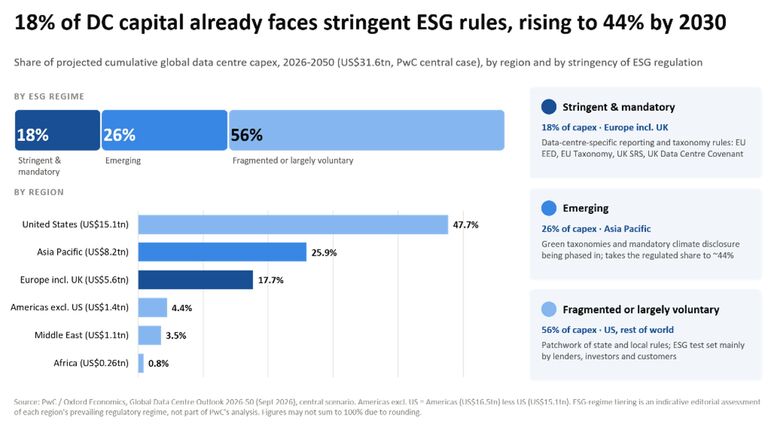
Capital markets are not moving alone. Regulators are increasingly connecting environmental performance with the right to develop and operate.
In the EU, data centres of 500 kW or more already have annual energy and sustainability reporting obligations, and the European Commission has adopted an A-G sustainability rating scheme based on measures including PUE and water-use effectiveness.
Ireland provides an even stronger signal. New data centres must provide dispatchable generation or storage covering 100% of import capacity and source at least 80% of annual demand from new Irish renewables, or risk reductions in grid capacity. Singapore is similarly prioritising new capacity for facilities demonstrating leading efficiency, green energy and credible low-carbon plans.
The message is becoming difficult to miss: ESG is starting to influence who gets power, who gets finance and, ultimately, who gets to grow.
The evolving UK ESG landscape
The UK is moving in the same direction. From November 2026, nationally significant data-centre developments must deliver at least 10% biodiversity net gain, with significant on-site gains maintained for at least 30 years. The UK Data Centre Covenant also connects strategically important development with expectations around efficient energy and water use and community benefit, alongside potential government support.
Doing nothing carries its own cost. In the US, at least 75 data-centre projects worth around US$130 billion were reported blocked or delayed by local opposition in the first quarter of 2026, with concerns focused on energy, water, land and electricity costs.
That should get the attention of any board considering a major development programme.
From compliance to opportunity
The opportunity is to move ESG upstream, before the decisions that determine environmental performance, project risk and ultimately investability have already been made. Four practical actions include:
Engage.
Bring customers, utilities, regulators, communities, technology providers and the supply chain into the conversation early. In a market where community opposition, grid constraints and water concerns can delay projects, stakeholder engagement is increasingly part of development risk management, not simply corporate communications.
Plan.
Define what good looks like before capital is committed. Establish credible baselines and measurable targets for PUE, water, renewable power, carbon and wider ESG performance. With lenders already linking financing terms to these metrics, good data can increasingly support a stronger investment case.
Design.
Translate those ambitions into engineering requirements early enough to make a difference. Decisions on power, cooling, water, technology and site configuration made during front-end development can materially influence both environmental performance and long-term project risk.
Embed.
Finally, make ESG part of how investment decisions are made, not a report produced afterwards. Put sustainability evidence alongside cost, schedule, reliability and return in investment cases, due diligence and risk assessments. That is where ESG moves from compliance to competitive advantage.
There is another reason to act now. Investors are asking for more granular evidence. Shareholders have pressed Amazon, Microsoft and Alphabet for site-level water information, while GRESB and Infrastructure Masons have launched a global sustainability benchmark designed specifically to support data-centre investment, risk assessment and due diligence.
The direction of travel seems clear.
The next generation of winning data-centre projects will not simply be those that secure land and power fastest. They will be those that can demonstrate why they deserve capital, consent and community confidence.
That is the real opportunity: get ESG right, and it stops being another constraint on data-centre growth.
Get in touch
Contact us
If you require more information, please contact your local Genesis representative.